Start with the milestone you actually agreed
Open the signed private contract, milestone schedule, scope sheet and latest drawing register together. A label such as “structure complete” can hide different meanings, so identify locations, included activities, stated evidence and dependencies. Note whether the milestone is based on measured work, an inspection, a deliverable or a combination. Do not substitute a public-works procedure for the private agreement.
The Department of Expenditure’s Works Manual, Second Edition 2025, discusses measurement and payment records in section 5.2 and variation tracking in section 7.3.2. These are public-procurement documentation examples, not private Bengaluru contract rules. The checklist below is an original editorial aid: use the evidence, review roles and response times agreed for your own project.
Request a claim packet that another person can follow
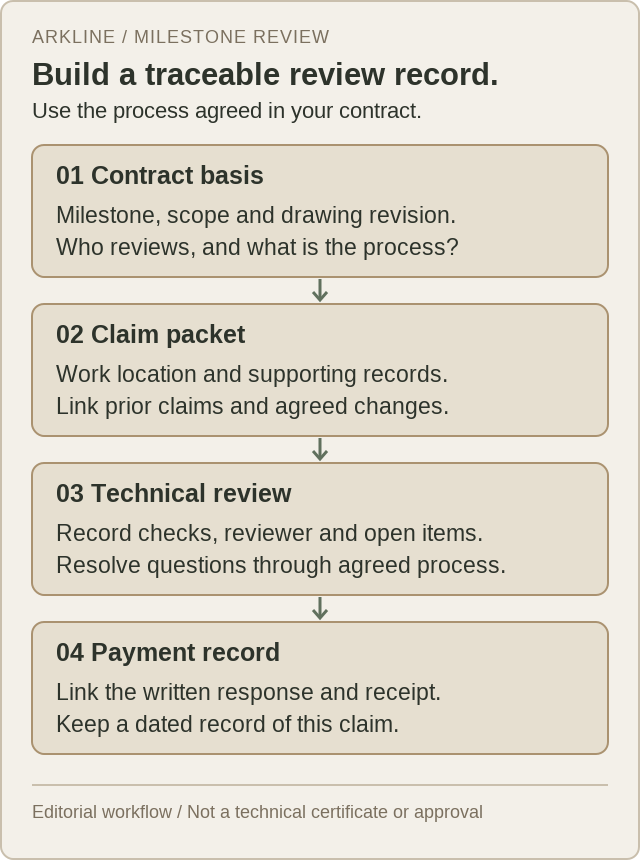
Ask the contractor or project coordinator to identify the milestone, site areas and claim period, then reference the agreed scope and drawing revision. Request a short progress statement showing what is complete, what remains and what is inaccessible or not yet verifiable. If work is measured, ask for the relevant measurement sheet or summary. If an appointed architect, engineer or quantity surveyor is engaged, ask that person to record the inspection, measurement or professional review they are responsible for. A homeowner should not improvise structural testing or certify concealed work.
| Claim evidence | Owner review record |
|---|---|
| Milestone name, locations and contract reference | Which agreed definition and drawing revision were checked? |
| Progress statement, measurements or inspection note | Who observed or measured it, and what remains open? |
| Dated photographs with room or grid context | Which parts are visible only, and which need professional confirmation? |
| Approved variation or substitution references | Is the change in the current scope and drawing register? |
| Current claim and prior approved claims | Does the running record avoid counting the same work twice? |
| Invoice or payment request | What decision, date and receipt will be stored privately? |
Photographs are useful for orientation and sequence, especially before work is covered. They are not proof that a concealed reinforcement, waterproofing layer, service route or connection meets a specification. Ask the responsible professional what inspection or test record is appropriate for the actual work.
Reconcile the claim before treating it as ready
Keep a simple running schedule with the original scope, approved changes, prior paid or approved claims, the current request and items still under review. Keep “approved” and “paid” as separate statuses: approval alone does not show that money was received. Link every addition, deletion or substitution to its change note and drawing revision. If a quantity or finish differs from the agreed document, record whether it is an approved variation, a correction, or an open question.
Illustrative claim-review entry
- Milestone: first-floor masonry and service rough-in, as defined in this example’s agreement.
- Documents: signed scope, current plan revision and prior claim log.
- Evidence received: location-indexed progress note, appointed engineer’s inspection observation and photographs taken before concealment.
- Open questions: one service route needs its revised coordination drawing; one substitution lacks written approval.
- Next action: record those questions, name the person responding and record the response date agreed through the contract process. File the eventual decision and private receipt under the same claim reference.
If the claim is unclear, send the questions through the communication route in the contract. This sample record does not decide whether payment is due or authorize withholding it. Follow the agreement and get project-specific professional advice where the issue affects safety, structure, services or a disputed interpretation.
Close the record after the decision
Once the authorized parties decide, record the date, status, documents reviewed, unresolved items and next action owner. Keep the current drawing register and change log aligned with the site copy. Store the payment request, approval note and private receipt together. Limit the file to project information needed for coordination; do not publish personal banking or contact details.
If an architect, engineer or quantity surveyor is not engaged, follow the private contract’s evidence requirements; do not present a self-made checklist as professional certification. For unclear terms, ask a qualified adviser to interpret the actual documents. Records improve the conversation, but do not replace technical inspection, contract review or legal advice.
Take this to your next meeting
Your site checklist
- Open the signed contract, milestone schedule, current drawing register and prior claim record together.
- Ask for a location-based progress statement and the measurement or inspection evidence required by the agreement.
- Use appointed architect, engineer or quantity surveyor records where engaged; do not self-certify concealed or structural work.
- Treat photographs as context, and ask what professional inspection or test record supports work that will be covered.
- Link variations, substitutions and deletions to their written approval and current drawing revision.
- Record current versus prior claims, open questions, decision status and the private payment receipt under one reference.
Common questions
What should I request with every milestone claim?
Request the milestone and contract reference, locations, current drawing revision, progress or measurement summary, relevant inspection or test records, approved variation references, prior-claim reconciliation and a list of open items. Use the evidence and approval process in your signed agreement.
Are site photos enough to approve concealed work?
No. Photos help show location and sequence, but they cannot establish the quality of concealed work by themselves. Ask the appointed professional what inspection, measurement or test record is appropriate before the work is covered.
What if the claim does not match the latest drawing?
Record the mismatch and identify the document that needs clarification. Ask the responsible designer or professional to confirm the current scope, and link any agreed change to a dated written record before the project file is closed.
Reading notes
Sources & further reading
Checked on the dates below. Official requirements and documents can change; confirm the version that applies to your site.
- Department of Expenditure: Works Manual, Second Edition 2025 - sections 5.2 and 7.3.2 (public procurement examples) Accessed 22 November 2026