

Start with a water map
Sketch each roof plane and note where existing downpipes discharge. A flat terrace, tiled slope, balcony canopy and paved courtyard do not necessarily contribute to one convenient collection point. Also note roof access, trees that drop leaves, solar equipment, tank locations, and where stormwater currently leaves the plot. This simple map helps an architect or rainwater-harvesting specialist spot conflicts before pipes and storage are fixed.
For a rough scale check, use the transparent relationship: catchment area × rainfall depth × collection factor. For example, 80 m² × 20 mm (0.02 m) × 0.8 = 1.28 m³, or 1,280 litres. This is an illustrative single-event calculation, not a Bengaluru rainfall forecast or a promise of usable supply. Actual capture varies with rain intensity, roof material and condition, losses at the first flush and filter, and whether the tank has room when rain arrives. CSE describes catchment, conveyance, filtration, storage and recharge as connected parts of a system. CSE: Components of a rainwater harvesting system
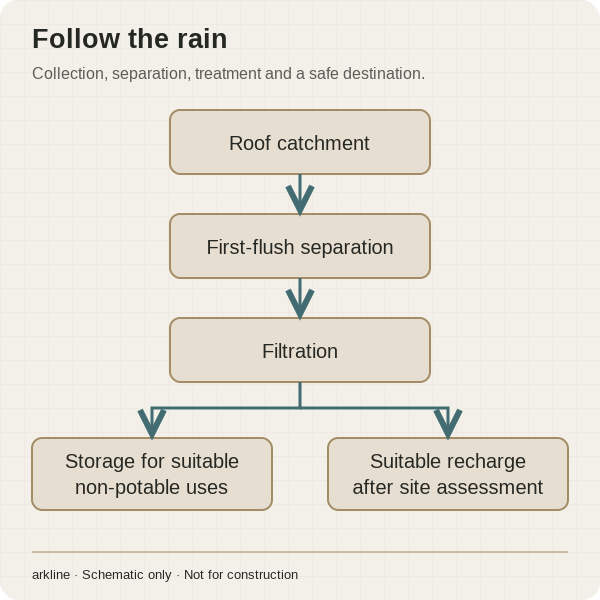
Choose storage, recharge or both
Storage makes captured water available later, but it occupies space and needs a covered, accessible tank plus a defined use. Garden watering, cleaning and toilet flushing may suit a home with appropriate plumbing separation and maintenance. Do not assume harvested roof water is safe to drink: roof debris, bird droppings, airborne deposits, storage conditions and treatment all affect quality. Drinking use requires suitable treatment and testing by competent providers.
Recharge directs suitably managed runoff into the ground, but site geology, groundwater conditions, contamination risks, nearby foundations and existing utilities matter. A recharge feature that works on one Bengaluru plot may be unsuitable on another. Ask a qualified practitioner to assess the site rather than selecting a pit or well from a generic diagram. Combining storage and recharge can make sense when the layout supports it: use some water, then route excess through an approved, maintainable overflow path.
BWSSB's official site promotes rainwater harvesting, while the Karnataka State Council for Science and Technology (KSCST) hosts BWSSB-related RWH material and a helpdesk. Rules and applicability depend on the property and current jurisdiction; check directly with BWSSB or the relevant authority before relying on an older summary or assuming a project is compliant. BWSSB · KSCST Rainwater Harvesting Helpdesk
Keep the route clean and maintainable
Roof runoff needs a debris screen, a way to discard the dirtier initial flow after a dry spell, and filtration suited to the intended use. These parts do not eliminate the need for cleaning. Before the rains, clear roof outlets and gutters, inspect the first-flush and filter arrangements, and confirm that tank covers and overflow routes are unobstructed. CSE's maintenance guidance also emphasizes keeping catchments clean and maintaining filters and diversion arrangements. CSE: Rainwater harvesting maintenance
Ask the designer to identify who can safely reach each component, how settled material will be removed, where rejected water goes, and how the system is isolated if a component needs repair. Keep a simple log of cleaning dates, visible sediment or odour, filter changes, water level and any overflow or leakage. For non-potable use, label the supply and keep it physically separated from drinking-water plumbing. Review water quality if the use or source changes. A useful system is one the household can inspect and maintain without improvising on a wet roof.
Compare the planning options
| Approach | Useful when | Trade-off to discuss |
|---|---|---|
| Covered storage | You have a clear non-potable use and a safe tank location. | Space, access, plumbing separation and storage capacity. |
| Ground recharge | Site conditions and local assessment support infiltration. | Soil and groundwater suitability, contamination control and maintenance access. |
| Storage plus overflow/recharge | You want to use some captured water and manage surplus. | More interfaces to coordinate and maintain; overflow still needs a safe destination. |
Use this as a discussion aid, not a design specification. Have the professional coordinate roof drainage, water use and site drainage so harvested water does not back up toward the home or neighbouring property.
Take this to your next meeting
Your site checklist
- Map roof areas, outlets and current discharge points.
- Decide the intended use before choosing storage or recharge.
- Ask how debris screening, first flush, filtration and overflow will work together.
- Confirm safe access, cleaning responsibility and plumbing separation.
- Verify current local requirements and site suitability with the relevant authority and qualified designer.
Common questions
Can I drink rainwater collected from my roof?
Do not assume it is potable. Roof and storage contamination vary; drinking use needs appropriate treatment, testing and professional advice.
Is storage always better than groundwater recharge?
No. Storage supports later use but takes space; recharge depends on local ground conditions and safe design. Some sites may suit a combined approach.
How much water will my Bengaluru roof collect?
It depends on the actual rainfall event, connected catchment, roof condition, losses and available storage. The 1,280-litre example above only illustrates the calculation.
Reading notes
Sources & further reading
Checked on the dates below. Official requirements and documents can change; confirm the version that applies to your site.
- BWSSB official website Accessed 10 November 2026
- KSCST Rainwater Harvesting Helpdesk Accessed 10 November 2026
- CSE: Components of a rainwater harvesting system Accessed 10 November 2026
- CSE: Maintenance of rainwater harvesting systems Accessed 10 November 2026